How SEIF works
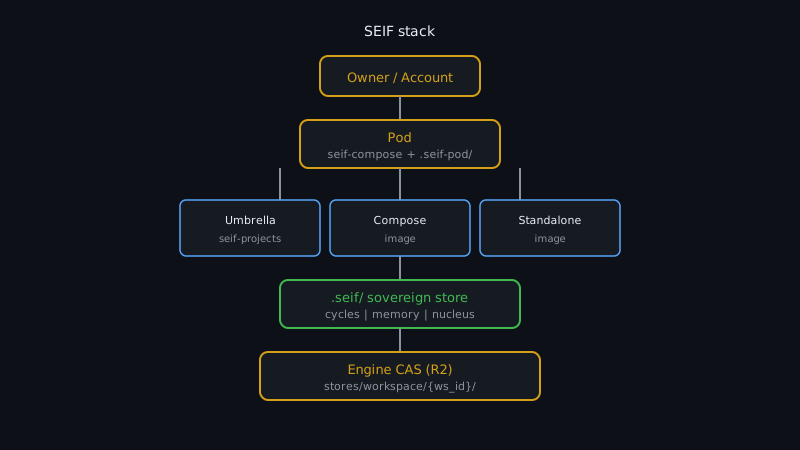
SEIF is git and Docker for AI context: sovereign workspaces, Pods that orchestrate them, and an engine CAS you can verify in public.
View diagram source (Mermaid)
flowchart TB
  Account --> Pod
  Pod --> Umbrella[Umbrella image]
  Pod --> Standalone[Standalone image]
  Pod --> Compose[Compose-image]
  Umbrella --> Store[".seif/ store"]
  Store --> CAS[Engine CAS]
Workspace image
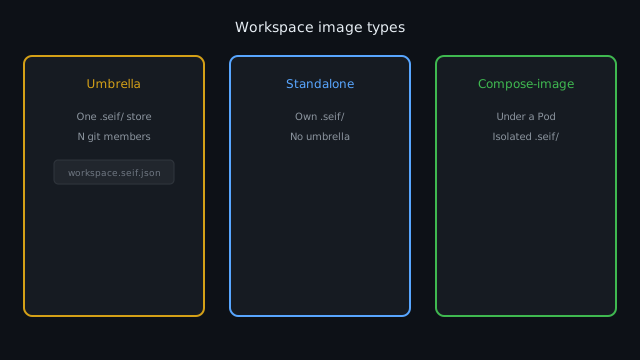
- Umbrella image — one canonical `.seif/` store, many pinned git members (e.g. seif-projects).
- Standalone image — its own `.seif/` and cycles; not a member of an umbrella.
- Compose-image — lives under a Pod; isolated `.seif/` per image in the manifest.
- Marked by `workspace.seif.json` (SEIF-WORKSPACE-v2) at the image root.
Org & team (governance)
- Company-long lifecycle — unlike ephemeral Pods that dissolve after a sprint.
- Teams hold grants; the engine resolver checks role and classification together.
- Ships after workspace membership v1 on the engine — UI will show an Org section in the switcher.
Workspace and Pod Access already show live people/grants (MEMBERSHIP-RESOLVER-v1). Org/team governance still lands later.
Pod
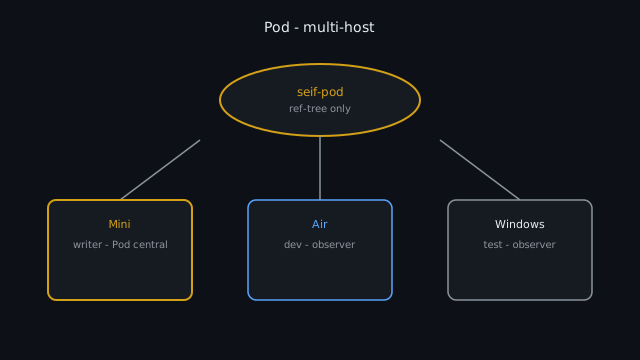
- Groups multiple workspace images under one host directory.
- `.seif-pod/` holds compose copy + `nucleus_ref.json` per image — not their sovereign data.
- Multi-host: Mini writer, Air observer, Windows test — same Pod, different machines.
- Run `seif compose push` to refresh pod refs and child nuclei.
Object model
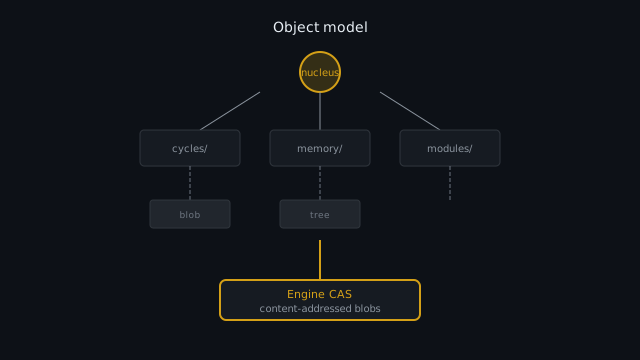
- Hierarchical tree-of-trees under `.seif/` (cycles, memory, modules…).
- Nucleus root anchors the workspace; gates run before finalize.
- Engine stores content-addressed blobs in CAS — pull by hash, verify by evidence.
- Browse the live-shaped tree in the demo Objects tab.
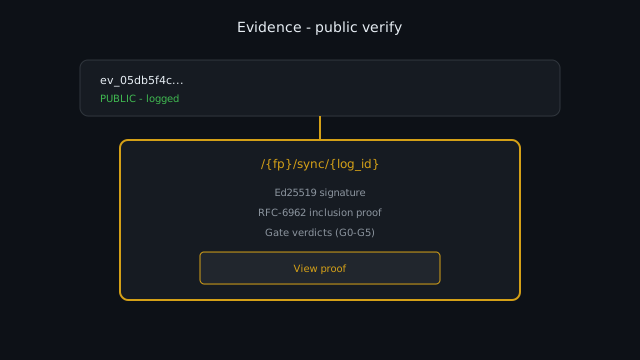
Evidence
- Signed artifacts live in your workspace evidence list.
- Logged entries expose `/{workspace_fp}/sync/{log_entry_id}` — no login required.
- RFC-6962 inclusion proof + gate verdicts on the verify page (when log is wired).
- Local-only evidence stays local — no false public verify affordance.
Local store vs Engine CAS
- Local `.seif/` is sovereign on your disk — you own the store.
- Engine workspace id (`ws_*`) names the remote CAS bucket after `seif push`.
- Pod paths use `stores/pod/{pod_id}/` when compose sync is enabled.
- Auth and metadata live in the managed database; blobs in object storage — the browser never parses `.seif/`.
At a glance
| Workspace image | Pod | Engine CAS | |
|---|---|---|---|
| Git / Docker analog | Git repo / project | docker-compose stack | Container registry (CAS) |
| What it owns | `.seif/` sovereign store + nucleus | `.seif-pod/` refs + N workspace images | `stores/workspace/{ws_id}/` blobs |
| Typical use | One team, one scope (umbrella or standalone) | Multi-host, multi-workspace orchestration | Sync target after `seif push` |
Why SEIF, not…
Claude ProjectsClaude Projects — Per-vendor, per-conversation. SEIF persists across agents and machines; you own `.seif/`.
Cursor RulesCursor Rules — Static prompts in one IDE. SEIF modules are signed, classified, audit-logged artifacts.
Copilot WorkspaceCopilot Workspace — Repo-scoped, no transparency log. SEIF spans repos and produces regulator-grade evidence.